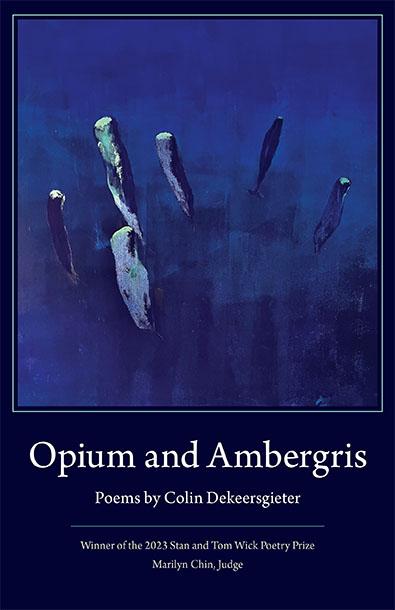
72 pages, 5 1/2 x 8 1/2
Paperback $18.00
ISBN 978-1-60635-483-4

Shipping Status: Preorder
Winner of the 2023 Stan and Tom Wick Poetry Prize
Reeling from the loss of his brother to a heroin overdose, Dekeersgieter grieves while doing his best to keep his depressed mother alive and raise his family. As a result, these poems shift between historical retellings and urgent examinations of love. In the title poem, “opium” is associated with death and “ambergris”—a substance formed in sperm whales’ digestive tracts and valued by many cultures for over one thousand years—is associated with love. As family history, death, trauma, and duty become entwined with the acts of living, suffering, growing, and writing, these metaphorical categories become essentially interchangeable. Opium comes from the beautiful poppy; ambergris is an ingredient still used in high-end perfumes to help the fragrance last longer, yet it is extracted from dead whales. Thus, “opium” and “ambergris” come to represent the possible coexistence of love and loss.
Opium and Ambergris is the haunting debut collection by poet Colin Dekeersgieter, whose lyric poems scrutinize a family’s history with addiction, death, and mental illness.
With many poems written in emergency departments, behavioral wards, and intensive care units, Dekeersgieter does not just honestly chronicle a family crisis but seeks to survive through poetry.
“What a daring book! In these lush, courageous, Stevensian poems Colin Dekeersgieter takes a harrowing family past and transforms it into something opulent and lasting. I am moved and heartened by the way he uses the high art of poetry as a survival tool to reconfigure memory and outwit oblivion.” – Edward Hirsch
“The laments and portraits of addictive trauma in Colin Dekeersgieter’s Opium and Ambergris are shot through with glimmers of love, hope, and radical new ways of saying. Dekeersgieter harnesses the mundane to the spiritual, the violent to the tender: these contraries speak, with a warped force, of griefs, anxieties, and fears perhaps too overpowering to handle in any other way. In this debut, endurance and love are nowhere taken for granted; they are elixirs in moments of imperiled waiting, ecstatic self-abnegation, and destructive bravura, all conveyed in a wholly new idiom. These poems woo an oblivion that seeks to lure the speaker—the singer of these “sound delusions”—away from heartbreaking realizations. There is nothing sentimental in these poems of deep feeling. The presence of a child sets the poems shimmering.” – Catherine Barnett
“Dekeersgieter likes to maximize the sonic potential of every line, as if to squeeze from the sentences a balm or retribution that words can’t provide unless wrenched out of place. And like Lucille Clifton, Dekeersgieter insists that the story be told honestly and unsentimentally, just the material itself, no flights into the evasive distance. Opium and Ambergris is a finely formed book, and its dramatic lyrics have a beguiling flow, a movement not concealing the hard work of pushing tumultuous experience into cadenced language.” – Wayne Koestenbaum
“One of the wonders of poetry remains the endless possibility of feeling morphing into reverberant passages of the unexpected, echoing figures that alight upon a new thought or pathway to understanding the inscrutable. Colin Dekeersgieter’s Opium and Ambergris is unremitting on this score. These poems turn the copious glint and glimmer of language into resonant extensions of its themes. Thinking in this book is refreshingly physical and profoundly ethical in upholding the imagination as our great citadel of healing.” – Major Jackson
 The Broken Towers