What Makes Walt Whitman Whitmanian?

*

Hart Crane’s ‘Voyages II’

*
Hart Crane
Hart Crane

Emily Dickinson’s Neuroaesthetics

*

English: Daguerreotype of the poet Emily Dicki...The process of reading as well as the effect it has on us as individuals is only just beginning to be understood. Recent instruments of brain imaging such as positron emission tomography (PET) scans and functional magnetic resonance imaging (fMRI) have unleashed a bevy of information on our own neurology, bringing us closer and closer to understanding that slipping locus: mind. Floating within the liminal space between the empiric and the transcendent is art; at one point it seemed both fields grew parallel to one another, then they seemed to approach infinity asymptotically, now, in the field of neuroaesthetics, their paths will meet.

Emily Dickinson thrusts the entangled nature of art and science and the phenomenological experience of reading into our consciousness by disrupting or displacing it so that we consider our relation to not only what is being read but also our psychological self and our culture as a whole. Like many modern poets, Dickinson uses neologistic linguistic devices to corrupt language, so that we reassess our relation to it and the socio-cultural context in which it is placed. But her primary technique is elision, a method that demands we do not take her 
Basquiatlanguage for granted and slip into negligent forms of reading or contentment with the world of her poetry. Jean-Michel Basquiat once said, ‘I cross out words so you will see them more: the fact they are obscured makes you want to read more.’ Through linguistic obfuscation or total elision, Dickinson accomplish the same thing, reflecting and elucidating the functions of reading language for the reader.

Stanislas Dehaene’s Reading in the Brain: The Science and Evolution of a Human Invention (2009) offers a relatively simple definition of the neurological complexities in the process of reading. Dehaene writes, ‘Written word processing starts in our eyes. Only the center of the retina, called the fovea, has a fine enough resolution to allow for the recognition of small print. Our gaze must therefore move around the page constantly. Whenever our eyes stop, we recognize one or two words. Each of them is then split up into myriad fragments by retinal neurons and must be put back together before it can be recognized. Our visual system progressively extracts graphemes, syllables, prefixes, suffixes, and root words. Two major parallel processing routes eventually come into play: the phonological route, which converts letters into speech sound, and the lexical route, which gives access to a mental dictionary of word meaning’ (9 [italics mine]).

The act of reading involves the process of encoding, retrieval, and decoding. Overtime our neurons become trained, internalizing graphic signs in constituent parts, i.e. phonemes and graphemes. Each time we look at a word, synapses fire in order for the brain to retrieve information from within memory banks and subsequently sift through their potential meanings. This process occurs within approximately a tenth to a half a second. The eye shifts back and forth intermittently, pausing at moments when the brain decodes small chains of language or when the eye must respond to changes in light or other external shifts in the surrounding environment. These movements of the eye are called saccades. Saccadic movement allows the fovea to scan lines of text, as the fovea is only wide enough to see six to seven characters at a time. The encoded graphic representations of language are then sent (primarily) to an area located in the occipital region of the brain where encoded language is decoded through a process Dehaene calls ‘neuronal recycling,’ allowing the brain to recall patterns and become attuned to the subtleties of language, such as homonym. All of this takes an incredible amount of neurological activity and thus energy and heightens the significance of language in the development of not only culture but also who we are as individuals.

In 1862 Dickinson experienced her greatest moment of personal and mental turmoil, however it was also her most prolific period in which she wrote 366 poems. Capitalizing on the somewhat vague understanding of Dickinson’s condition, psychoanalysts often studied this period of Dickinson’s work to show the significant fragmentation in the processes of thought during psychotic breakdowns. Perhaps her agoraphobia allowed her to regress into her interiority due to little contact with the outside world or maybe her anxiety was sublimated into art (likely both); whatever the cause of her creative energy, it is during this time that her poetry seems to focus most heavily on the manner in which body and brain receive information.

As we have seen in the brief introduction to the neurology of reading, the brain receives graphemes (and most information) in fragmented units and subsequently interprets coherent wholes out of them, oftentimes intercalating the missing pieces. Given that the mind only registers one or two words at each pause, Dickinson’s dash takes on great importance in regard to the way we read and understand her work. In implementing the dash, Dickinson is asking the mind to pause in order for it to register unconsciously what it has just encoded, allowing the decoding process to initiate before the movement to the next graphic chain, thereby providing a neurologic immediacy to the process of reading her work. This is an important aspect of Dickinson’s poetry as her elision often renders syntactical meaning perplexing. Through fragmentation, the brain slows and processes what it is reading, interpolates the elided information, and focuses on the language present. This seems counterintuitive to what the dashes and the abstraction of Dickinson’s work seem to be accomplishing (or not accomplishing) superficially. The dash does sometimes speed up the reader consciously but by placing this meaningless (meaningless in that it has no lexical meaning) graphic, the brain processes the information better. It is this type of poetic trickery or obfuscation that makes her poetry so immediate, so physical. Consider how important each chain becomes in ‘Departed – to the judgment –’(1862):

Departed – to the judgment –
A Mighty Afternoon –
Great Clouds – like Ushers – leaning –
Creation – looking on –
The flesh – Surrendered – Cancelled –
The Bodiless – begun –
Two Worlds – like Audiences – disperse –
And leave the Soul – alone –

She seems aware of the saccadic movement of the eye and the importance it has in reading and is therefore asking us to slow down, to encode/decode the unit before moving on to the next chain or line; she wants our attention to remain for some time on the segments delineated by the dash before continuing and she does not want to fill the space with conjunctions, prepositions or useless language.

The abstraction present in this poem is typical of Dickinson and furthers our desires to pay particular attention to the language. The poem seems to be about the soul’s state after death under that public eye of nature; it is a dying into nature whereby the body is surrendered and cancelled. The setting of the death is a storm. In a letter discussing her growing dependence upon her sister and her fear of being alone, Dickinson writes, ‘Vinnie has been all, so long, I feel the oddest fright at parting with her for an hour, lest a storm arise, and I go unsheltered’ (Letter 200). Storms become an important symbol and metaphor of psychological torment; read this way, the poem is enacting the psychological state of a panic attack. Anxiety is the term for a fear without a specific focus and patients describe them ‘as a simulation of death’ (McDermott). (Dickinson’s panic attacks were probably the reason for her obsession with death and the persistent placement of the speaker in the very act of dying or beyond the grave.) In the poem, ‘Two Worlds’ are leaving the ‘Soul – alone’, one is explicitly the body and so the second (because it cannot be the Soul which leaves the Soul alone) is likely the mind; thus the speaker is experiencing being both without body and without mind. During panic attacks, patients describe the feelings of being disconnected from their body and that they are ‘going insane.’ In this poem Dickinson is relaying through form the psychological distress of death or impending doom whose locus is indeterminate or abstract, hence the poem’s enigmatic nature. The form and content represent that ‘snarl in the brain’ present during her greatest moments of psychological torment.

The cryptic nature of Dickinson’s poetry is also due to the fact that she is often skeptical of religion, afterlife, and morality as well as the manner in which humans are able to receive and subsequently record external phenomena. In her poetry, this skepticism is often the result of the tender and quite capricious nature of the brain’s neurological makeup, which, according to Joseph LeDoux, is what makes the self: he calls this notion the synaptic self. It is clear that synapses allow us to be; the unconscious processes of synaptic firings allow us to breathe, sit, walk, think, speak, read etc. However, LeDoux argues that synapses are as important as nature (genetics) and nurture (or religion, culture etc.). An important aspect of this theory is that because we are consistently changing physiologically, our mindset changes as well. We are, by the very nature of our somewhat whimsical synapses, protean. Helen Vendler writes that Dickinson creates ‘structures that mimic the structure of life at any moment she conceives it’ and ‘[b]y those structures…channels our reactions, adjusts our pace to her and molds our thinking after her own’ (34).  Dickinson discusses the manner in which our brains often run counter to ourselves (a theme taken up in my post on Frost’s ‘Spring Pools’) despite our desires to think differently in ‘I felt a Cleaving in my Mind’ (1864).

I felt a Cleaving in my Mind—
As if my Brain had split—
I tried to match it—Seam by Seam—
But could not make it fit.

The thought behind, I strove to join
Unto the thought before—
But Sequence ravelled out of Sound
Like Balls—upon a Floor.

For Dickinson, the fissure in the mind feels like it is a direct result of the brain’s being split: she initiates with the Whitmanian thesis: ‘[w]e do not have a body, we are a body’ (Lehrer). While this poem discusses cognitive disjunction known to everyone, the language chosen as well as the form into which it is placed heightens the problem of the poem by making that very problem latent in the diction and syntax.

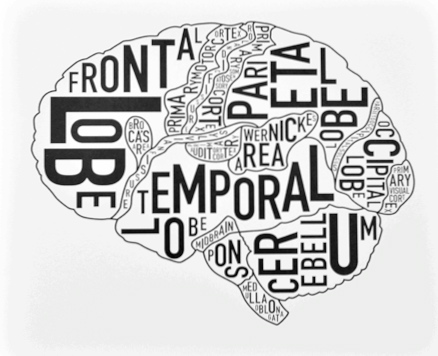
lobessssIn the process of reading, the visual recognition of word triggers myriad neurological circuits that have been conditioned and fortified through our environment, learning, and reading behaviors. With the recognition of a graphic form as a potential grapheme or word, we begin the process of decoding the smallest groupings of letters into potential words while simultaneously seeking in lexical and auditory memory banks, memories that we can apply to what is seen. The brain does not do this immediately, and so it must sequence patterns of recognition to seek out banks of possible auditory and lexical meaning. Overtime, through the process of reading and ‘neuron recycling,’ the brain becomes aware of homonyms and understands it must differentiate these twinned lexical graphics using contextual signs. However, this is not always immediately possible, and so meanings slide and we fall victim to innocent parapraxis while reading or speaking. In ‘I felt a Cleaving in my Mind’ the difficulty of the poem is substantiated by homonymic difficulties, echoing in the reader’s mind the struggle which Dickinson is discussing.

In the Oxford English Dictionary, the verb cleave has two separate meanings. The first is (1) ‘To part or divide by a cutting blow; to hew asunder; to split’. The second meaning is its exact opposite: (2) ‘To attach to.’ (Because the line break is accentuated by the dash, the brain may register this latter meaning first). At the close of the second line—with that hard split—the meaning becomes clear and the cleaving is a splitting. What makes this homonymic moment more impressive is the fact that Dickinson is lamenting the loss of the second meaning, she in fact wishes her mind would cleave (2) and not cleave (1). This would lack importance if it were an insolated incident within the poem, however Dickinson repeats the lexical trickery with the word ravel. Here ravel in fact has three meanings. (1) ‘To entangle; to confuse, perplex; to render incoherent or muddled;’ (2) ‘of a skein of yarn, a spool or reel of thread, etc.: to become unwound;’ and (3) ‘to knit or bring together.’ The superficial meaning is the first meaning (1): Dickinson cannot connect one thought to the next and is therefore confused. It is the last two meanings that perform the deception. Taking ‘Seam by Seam’ to be a knitting metaphor, ravel initially means that her thoughts are unwound; however, the secondary definition means that in its becoming unwound it is knit together, just as one must unravel a spool of thread to ravel (knit) an article of clothing. The sequence (patterning) ravels out of caterwauling auditory input (‘Balls – upon a floor’) and Dickinson is consciously unable to align her thinking patterns to that sequence; though subconsciously, on a neurological level, the brain is making meaning: on a superficial level the disparate meaning of lexical input is consciously rendered cryptic and yet meaning arises out of the mind’s ability to pattern properly, however unlikely it seems.

In her use of dichotomous language, Dickinson is lamenting not the fact that she cannot think properly but rather that this is in fact the process of thought, especially in times of psychological distress. The cleaving of the mind as a result of the brain’s splitting continues the theme of being disconnected from her body, and in that disconnect her thoughts become subject to the seemingly arbitrary will of synaptic energies, however it is those very energies that create the poem. Two years prior to the composition of this poem, and during a tumultuous time, Dickinson wrote on the notion of the brain’s arbitrary connections in ‘The Brain, within its Groove’ (1862):

The Brain, within its Groove
Runs evenly—and true—
But let a Splinter swerve—
‘Twere easier for You—
To put a Current back—
When Floods have slit the Hills—
And scooped a Turnpike for Themselves—
And trodden out the Mills—

This poem is attuned to LeDoux’s notion of the synaptic self whereby the self, as much at is informed by culture, religion, etc. is really dependent upon patterns of synapse. The brain is plastic and is changing constantly through synapses as we continue to change day to day. This plasticity not only literally reshapes our minds but also our personality, our thoughts and even our beliefs. Dickinson is stating, as countless neurologists have stated (and recidivists proven), it is easier to learn than it is to unlearn.

***

Works Cited:

Dehaene, Stanislas. Reading in the Brain: The Science and Evolution of a Human Invention. New York: Penguin Books, 2009.

Dickinson, Emily. The Letters of Emily Dickinson. Eds. Thomas H. Johnson & Theodora Ward, Cambridge: Harvard University Press, 1958.

Johnson, Thomas H. The Complete Poems of Emily Dickinson. Boston: Little, Brown and Company, 1960.

LeDoux, Joseph. Synaptic Self: How Our Brains Become Who We Are. New York: Penguin Books, 2003.

Lehrer, Jonah. Proust was a Neuroscientist. New York: Houghton Mifflin Company, 2007.

McDermott, John F. ‘Emily Dickinson’s “Nervous Prostration” and its Possible Relation to Her Work .’Emily Dickinson Journal. 9.1 (2008): 71-86.

Vendler, Helen. ‘Emily Dickinson Thinking.’ Parnassus 26.1 (2001): 34-56.

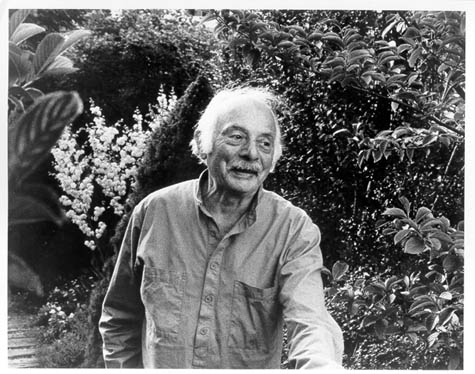
Stanley Kunitz: The Testing-Tree

*

Magic LanternI haven’t dreamed in months. My brain is numb with thinking, burned-out, gutted. I wake each morning to only the hoary, fragmented recollection of the pages I was reading before I fell into sleep, adrift in the glow of the kitchen light. I know that dreams had flickered and doused like lights in an electric storm, but they are impossibly distant (magic) lanterns and the mind’s nights are uneventful. So I have turned again to my dreamer, Stanley Kunitz.


Kunitz makes it into every important anthology and yet I’ve never heard his name murmured by graduates of verse in any 
New York City dive. Kunitz died in 2006 at the age of 100 and he racked up every important literary award and position along Kunitz1the way. His honors include the National Book Award, the Bollingen Prize, a Guggenheim Foundation fellowship, the State Poet of New York, the Pulitzer Prize, and the United States Poet Laureate. But no one seems to be writing or talking about this contemporary of Eliot, Pound, Frost, Stevens etc. whose wide-reaching influence includes Theodore Roethke, W.H. Auden, Robert Lowell, and so forth and so on until the early 21st century.

Kunitz’s ‘The Testing-Tree’ is one of his most visionary poems. In it, he progresses from a reflection on his childhood to, as he states, a recurring dream. In future, I will likely provide some entryways into the poem . But for now, I think it should only be read and read again. All I will say is listen to the voice. This is a voice that has lived. A voice that has loved and hurt, hurt and plunged, plunged and risen. It is an authoritative and chilling voice; a human voice whose heart ‘breaks and breaks / and lives by breaking.’ His is a voice that has dreamed and dreamed and dreamed.

Here’s the poem:

The Testing-Tree

1

On my way home from school
   up tribal Providence Hill
      past the Academy ballpark
where I could never hope to play
   I scuffed in the drainage ditch
      among the sodden seethe of leaves
hunting for perfect stones
   rolled out of glacial time
      into my pitcher's hand;
then sprinted lickety-
   split on my magic Keds
      from a crouching start,
scarcely touching the ground
   with my flying skin
      as I poured it on
for the prize of the mastery
   over that stretch of road,
      with no one no where to deny
when I flung myself down
   that on the given course
      I was the world's fastest human.


2

Around the bend
   that tried to loop me home
      dawdling came natural
across a nettled field
   riddled with rabbit-life
      where the bees sank sugar-wells
in the trunks of the maples
   and a stringy old lilac
      more than two stories tall
blazing with mildew
   remembered a door in the 
      long teeth of the woods.
All of it happened slow:
   brushing the stickseed off,
      wading through jewelweed
strangled by angel's hair,
   spotting the print of the deer
      and the red fox's scats.
Once I owned the key
   to an umbrageous trail
      thickened with mosses
where flickering presences
   gave me right of passage
      as I followed in the steps
of straight-backed Massassoit
   soundlessly heel-and-toe
      practicing my Indian walk.


3

Past the abandoned quarry
   where the pale sun bobbed
      in the sump of the granite,
past copperhead ledge,
   where the ferns gave foothold,
      I walked, deliberate,
on to the clearing,
   with the stones in my pocket
      changing to oracles
and my coiled ear tuned
   to the slightest leaf-stir.
      I had kept my appointment.
There I stood in the shadow,
   at fifty measured paces,
      of the inexhaustible oak,
tyrant and target,
   Jehovah of acorns,
      watchtower of the thunders,
that locked King Philip's War
   in its annulated core
      under the cut of my name.
Father wherever you are
    I have only three throws
       bless my good right arm.
In the haze of afternoon,
   while the air flowed saffron,
      I played my game for keeps--
for love, for poetry,
   and for eternal life--
      after the trials of summer.

4

In the recurring dream
   my mother stands
      in her bridal gown
under the burning lilac,
   with Bernard Shaw and Bertie
      Russell kissing her hands;
the house behind her is in ruins;
   she is wearing an owl's face
      and makes barking noises.
Her minatory finger points.
   I pass through the cardboard doorway
      askew in the field
and peer down a well
   where an albino walrus huffs.
      He has the gentlest eyes.
If the dirt keeps sifting in,
   staining the water yellow,
      why should I be blamed?
Never try to explain.
   That single Model A
      sputtering up the grade
unfurled a highway behind
   where the tanks maneuver,
      revolving their turrets.
In a murderous time
   the heart breaks and breaks
      and lives by breaking.
It is necessary to go
   through dark and deeper dark
      and not to turn.
I am looking for the trail.
   Where is my testing-tree?
      Give me back my stones!

Wallace Stevens: Of Modern Poetry

*

The question of the appeal of modern poetry is a very big concern among modernists and a common question among readers new to the genre. Many prefer the aesthetics of the Elizabethan’s, enjoying the sing-song simplicity and rhyme. Often, when I tell people that I am passionate about modern poetry they ask, ‘Why?’ Some objectors of the place of poetry even use (in so many words) W.H. Auden’s line in his elegy to W.B. Yeats, seemingly unaware of the contradiction: ‘poetry makes nothing happen.’

When I consider what people call the difficulty of modern poetry I think of two things, T.S. Eliot’s essay ‘The Metaphysical Poets’ and Wallace Stevens’s poem ‘Of Modern Poetry.’ Eliot writes, ‘Our civilization comprehends great variety and complexity, and this variety and complexity, playing upon a refined sensibility, must produce various and complex results. The poet must become more and more comprehensive, more allusive, more indirect, in order to force, to dislocate if necessary, language into his meaning.’ Here modernists might discuss modernism’s tearing into pieces of the interiority of humanity as a result of some great event, and I do not deny that modernism consists of the ‘refined sensibility’ reacting to that (or those) events. However, the events and the emotions tied to the events are seldom new (though the events may be more monumental, the emotions more intense); the difficulty is in the projection of a subjective interiority that has always existed and has always been complex.

Modern art in PragueWallace Stevens’s ‘Of Modern Poetry’ begins with what I believe is a sense of Durkheim’s social Anomie. Modern poetry is the attempt to grasp and delineate something that cannot yet be understood by society at large. In this sense it is prophesying: modern poetry ‘has / To construct a new stage’ on which the norms of society will be played out after it is ruptured by anything: war, economic collapse, drought, etc. Stevens’s act of poetry, which is the act of the mind, is simultaneously solipsistic and intersubjective: it is for the self and the ‘invisible audience’ or collective consciousness of humanity. Stevens repeats what Keats wrote in ‘A Defence of Poetry’ [sic] : ‘Poets are the unacknowledged legislators of the world’ (Anomie is from the Greek and translates to ‘without law’). In times of great variety and complexity, the mind will mirror that state. ‘The poem of the act of the mind’ is ‘difficult’ because it is the mapping of the intricacy of your (his, hers, theirs, our) mind. Poetry is there to recreate, to compose law, it is there to remind us of what it is that makes us human, and, more importantly, to remind us of what makes us a society.

Here’s the poem.

Of Modern Poetry

The poem of the mind in the act of finding
What will suffice. It has not always had
To find: the scene was set; it repeated what
Was in the script.
Then the theatre was changed
To something else. Its past was a souvenir.

It has to be living, to learn the speech of the place.
It has to face the men of the time and to meet
The women of the time. It has to think about war
And it has to find what will suffice. It has
To construct a new stage. It has to be on that stage,
And, like an insatiable actor, slowly and
With meditation, speak words that in the ear,
In the delicatest ear of the mind, repeat,
Exactly, that which it wants to hear, at the sound
Of which, an invisible audience listens,
Not to the play, but to itself, expressed
In an emotion as of two people, as of two
Emotions becoming one. The actor is
A metaphysician in the dark, twanging
An instrument, twanging a wiry string that gives
Sounds passing through sudden rightnesses, wholly
Containing the mind, below which it cannot descend,
Beyond which it has no will to rise.
It must
Be the finding of a satisfaction, and may
Be of a man skating, a woman dancing, a woman
Combing. The poem of the act of the mind.

Gerard Manley Hopkins: The Windhover

*
dscf0043
Gerard Manley Hopkins, an English poet, Roman ...

T.S. Eliot: Ash Wednesday

*

01x/24/Dian/15120/007uToday is Ash Wednesday and although I did not want to provide a reading of a long poem for some time, I thought not posting on T.S. Eliot’s Ash Wednesday (1930) would be a lost opportunity. Below is a Dantean reading of Eliot’s poem. The wonder of Eliot’s poetry (like most great poetry) is that it can lead you anywhere. So read this post and take from it what you will but take a break before reading the poem. Grab a coffee, watch Downton Abbey, but try to read the poem without me in your head. I’d love to hear any interpretations. Enjoy.

For Eliot, Dante was more than a poetic master who had achieved the heights of poetry. As Eliot struggled through life literally searching for perfection, he rediscovered Dante, finding in his poetry not merely a poetics but also a way of life. Now, I don’t solely mean in regards to religion, in fact I am hardly concerned with religion at all. Eliot himself had written in that ‘It is wrong to think that there are parts of the Divine Comedy which are of interest only to Catholics’ and in his address ‘What Dante Means to Me’ (1950)—after his religious conversion—he stated, ‘to call [Dante] a “religious poet” would be to abate his universality.’ Eliot looked to Dante because Dante had succeeded in attaining the closest thing a poet could to poetical perfection, and he had done it regardless of the social and personal complexities of life. Eliot, initially captivated by Dante’s poetics, would come to grow engrossed by the man as their respective lives began to mirror one another to the extent that the modern and the medieval can.

Although Eliot’s early poetry uses many religious themes and motifs, it is not until 1925 that his poetry begins to convey any sort of leaning toward a single dogma. In fact, Eliot had regarded Buddhism as perhaps the most compelling form of spiritualism at the time of The Waste Land. Given these early, protean views, readers rising out of The Waste Land and moving directly into Ash Wednesday will experience one of poetry’s most difficult transitions in regards to philosophical positioning; however ambivalence may be what Eliot is attempting to convey, as it is his belief that the highest stage possible for the civilized man ‘is to unite the profoundest skepticism with the deepest faith.’
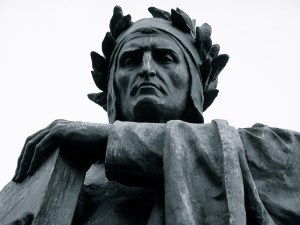
Dante StatueIn 1925—two years prior to his conversion and the subsequent writing of what is now part II of Ash Wednesday—Eliot had begun to reassess his studies of Dante. Sometime between 1926 and 1929 (the year Eliot published his most substantial work on Dante), he would come to parallel his beliefs most fundamentally with those of Dante’s. It is likely that—on some level—Dante influenced Eliot’s religious conversion. Despite its religious leanings, Ash Wednesday—as Eliot says of Dante’s Paradiso—is not didactic. The religious, Dantean themes in Ash Wednesday have been thoroughly excavated by scholars, as the allusions are relatively more palpable than they are in his other poetry. However, what is most important is that in Ash Wednesday Eliot searches for (and seems to gain) a particular assurance that his poetry can bridge the gap between the ‘low-dream’ of the modern world and the ‘high-dream’ of Dante’s vision. Ash Wednesday marks Eliot’s personal-poetic search for the ability to materialize the Word Incarnate with the written word.

Eliot’s view that ‘all faith should be seasoned with a skillful sauce of skepticism’ is what makes the first line of Ash Wednesday and the position of the speaker’s philosophy throughout so difficult to fully ascertain. Eliot institutes several disjunctive techniques as a type of objective correlative that sustains the vacillating nature of the speaker’s mind. These are the overlay of space and place, a lack of linearity, and ambiguous lexicon or multiple entendre. The ‘turn’ in the opening line of Ash Wednesday denotes the linchpin around which the whole poem rotates: ambiguity. The turn will come to signify the turning toward God, the look to a secular past, glimpses toward the future and many other possibilities. Most importantly, the turn is the repetitious but non-retrogressive movement from the active will to the contemplative mind.

Part I portrays the struggle between the individual’s will and intellect, collating the two pressing skepticisms within its ambiguity. That Eliot begins Ash Wednesday with an almost direct translation of Calvacanti followed by an almost direct quote from Shakespeare, marks Eliot’s first skepticism. The ‘gift’ Eliot desires to be gifted with is poetry that can transcend to heaven. Through the rewriting of text, Eliot tries to attain ‘a conception of poetry as a living whole of all the poetry that has ever been written.’ The word of the poet and the transcendent Word are wholly deliberated upon in both the fourth poem, in which the pure poetic imagination is considered, and the fifth poem, where the poet’s adequacy in the expression of reality is questioned. This questioning of his poetic transcendence is most explicitly present in his humility at the gate of Purgatory in the third poem: ‘Lord, I am not worthy / Lord, I am not worthy / but speak the word only.’

The passage through the gate of Purgatory will mark the full religious conversion and it is figured within a poem that is an exodus more fully realized than The Waste Land; the exodus here is one of necessary, willful expiation, as for Eliot the ascetic way of penance is the means to the way of grace. The will (which wavered in the opening poem) is strengthened in the final two lines, representing not the altered word of some poet but rather the pure speech of transcendence through the voice of the Churches invocation of Mary: ‘Pray for us sinners now and at the hour of our death.’ The death is the spiritual death leading to baptismal rebirth that Eliot had feared (‘Why should the aged eagle stretch its wings?’) out the outset.

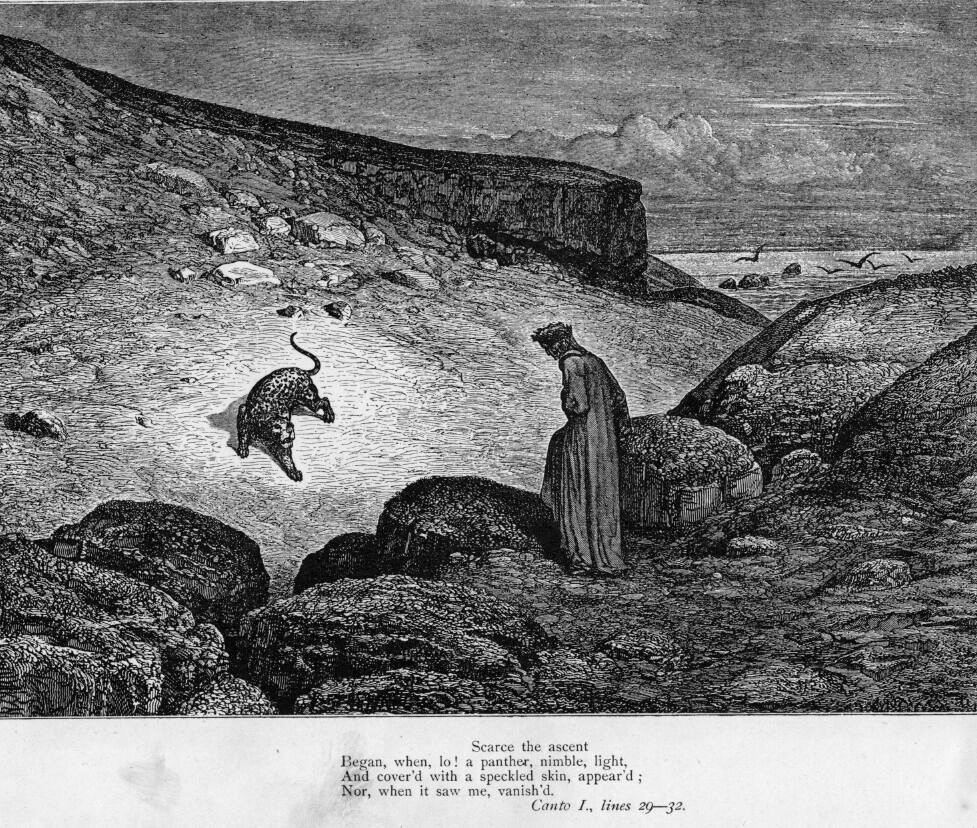
The second poem of Ash Wednesday was originally titled ‘Salutation’, referring to the first time Beatrice greets Dante in La Vita Nuova III: ‘with a salutation of such virtue that I thought then to see the world of blessedness.’ In La Vita Nuova, Dante struggles twice with the desire of the physical; first with Beatrice and later with a mysterious lady to whom he is attracted. It is possible that Eliot’s renunciation of the ‘blessèd face’ is in fact the physical face, which Dante renounced in order to attain salvation, and not a turning from the spiritual face. Dante LeopardThe ‘three white leopards,’ might be read as a positive inverse of the leopard of lust of Dante’s Inferno, representing a violent though willful expiation of lust. After the leopards have ‘fed to satiety on my heart my liver and that which had been contained / In the hollow round of my skull,’ the left over bones ‘shine with brightness’ because of the virtuousness of the Lady. The now pure essence of the speaker—the  ‘I who am’—is able to ‘Proffer [his] deeds to oblivion’ and his ‘love / To the posterity of the desert,’ which is at once in ‘The desert in the garden [and] the garden in the desert’ brought about by Mary, ‘The single Rose’ who is now ‘the Garden / Where all loves end.’
In Part III, the speaker has awoken from the dream of contemplation at the violet hour and come face-to-face with three stairs of the active will. The progression of the winding staircase holds in the balance the presence of a metaphysical poetry within the modern world. ‘The broadbacked figure drest in blue and green’ who enchants ‘the maytime with an antique flute’ is not only a look back to secular desires— figured here in pagan imagery—which once enchanted the heart, but, if it is succumbed to would assert that modern poetry is only capable of the ‘low-dream.’ For this reason the look back to the pagan imagery on the third stair can purgatoryonly be glimpsed through a ‘slotted window bellied like a fig’s fruit’ (109); the vision is impeded upon by the narrowed window of secularism because both the will and the intellect are torn between the secular wor(l)d and the Wor(l)d of God. As Eliot climbs the third stair, having gathered the ‘strength beyond hope and despair,’ he is able to humbly admit that he can ‘speak the word only’. After this admission, he is able to re-experience for himself the vision of God’s Word that he had only evinced through Ezekiel beneath the juniper tree, and he recapitulates the experience through the great mediator of the Word (Dante) who Eliot considered to have the gift of incarnation.
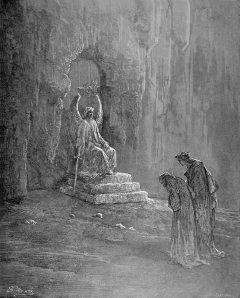
While walking ‘between the violet and the violet’ in a garden where the ‘fiddles and the flutes’ of the pagan scene have been ‘bear[ed] away’, Eliot is able to initiate his transcendence. His memories of the previous years are restored through a ‘bright of cloud tears’ and he subsequently will be able to write ‘With a new verse the ancient rhyme’ in order to ‘Redeem / The unread vision in the higher dream.’ Then the Lady, Word of no speech, ‘signed but spoke no word.’ Logos is witnessed but it is still mediated through an Other.

However, he does not experience the transcendental movement into the still point of Incarnation. He is still aware of the ‘the empty forms’ of the secular world and also that through the process of memory he may renew the ‘salt savour of the sandy earth.’ In this moment, when face-to-face with a carnal past, ‘the weak spirit quickens to rebel.’ It is not until the crucial moment when he ‘[spits] from the mouth the withered apple-seed’ thereby purging himself of humanity’s first failure that he can attempt to reach Logos on a personal and intellectual level.

Here’s the poem.

Ash Wednesday

I

Because I do not hope to turn again
Because I do not hope
Because I do not hope to turn
Desiring this man’s gift and that man’s scope
I no longer strive to strive towards such things
(Why should the aged eagle stretch its wings?)
Why should I mourn
The vanished power of the usual reign?

Because I do not hope to know again
The infirm glory of the positive hour
Because I do not think
Because I know I shall not know
The one veritable transitory power
Because I cannot drink
There, where trees flower, and springs flow, for there is nothing again

Because I know that time is always time
And place is always and only place
And what is actual is actual only for one time
And only for one place
I rejoice that things are as they are and
I renounce the blessed face
And renounce the voice
Because I cannot hope to turn again
Consequently I rejoice, having to construct something
Upon which to rejoice

And pray to God to have mercy upon us
And pray that I may forget
These matters that with myself I too much discuss
Too much explain
Because I do not hope to turn again
Let these words answer
For what is done, not to be done again
May the judgement not be too heavy upon us

Because these wings are no longer wings to fly
But merely vans to beat the air
The air which is now thoroughly small and dry
Smaller and dryer than the will
Teach us to care and not to care
Teach us to sit still.

Pray for us sinners now and at the hour of our death
Pray for us now and at the hour of our death.

II

Lady, three white leopards sat under a juniper-tree
In the cool of the day, having fed to satiety
On my legs my heart my liver and that which had been contained
In the hollow round of my skull. And God said
Shall these bones live? shall these
Bones live? And that which had been contained
In the bones (which were already dry) said chirping:
Because of the goodness of this Lady
And because of her loveliness, and because
She honours the Virgin in meditation,
We shine with brightness. And I who am here dissembled
Proffer my deeds to oblivion, and my love
To the posterity of the desert and the fruit of the gourd.
It is this which recovers
My guts the strings of my eyes and the indigestible portions
Which the leopards reject. The Lady is withdrawn
In a white gown, to contemplation, in a white gown.
Let the whiteness of bones atone to forgetfulness.
There is no life in them. As I am forgotten
And would be forgotten, so I would forget
Thus devoted, concentrated in purpose. And God said
Prophesy to the wind, to the wind only for only
The wind will listen. And the bones sang chirping
With the burden of the grasshopper, saying

Lady of silences
Calm and distressed
Torn and most whole
Rose of memory
Rose of forgetfulness
Exhausted and life-giving
Worried reposeful
The single Rose
Is now the Garden
Where all loves end
Terminate torment
Of love unsatisfied
The greater torment
Of love satisfied
End of the endless
Journey to no end
Conclusion of all that
Is inconclusible
Speech without word and
Word of no speech
Grace to the Mother
For the Garden
Where all love ends.

Under a juniper-tree the bones sang, scattered and shining
We are glad to be scattered, we did little good to each other,
Under a tree in the cool of the day, with the blessing of sand,
Forgetting themselves and each other, united
In the quiet of the desert. This is the land which ye
Shall divide by lot. And neither division nor unity
Matters. This is the land. We have our inheritance.

III

At the first turning of the second stair
I turned and saw below
The same shape twisted on the banister
Under the vapour in the fetid air
Struggling with the devil of the stairs who wears
The deceitul face of hope and of despair.

At the second turning of the second stair
I left them twisting, turning below;
There were no more faces and the stair was dark,
Damp, jagged, like an old man’s mouth drivelling, beyond repair,
Or the toothed gullet of an aged shark.

At the first turning of the third stair
Was a slotted window bellied like the figs’s fruit
And beyond the hawthorn blossom and a pasture scene
The broadbacked figure drest in blue and green
Enchanted the maytime with an antique flute.
Blown hair is sweet, brown hair over the mouth blown,
Lilac and brown hair;
Distraction, music of the flute, stops and steps of the mind over the third stair,
Fading, fading; strength beyond hope and despair
Climbing the third stair.

Lord, I am not worthy
but speak the word only.

IV

Who walked between the violet and the violet
Who walked between
The various ranks of varied green
Going in white and blue, in Mary’s colour,
Talking of trivial things
In ignorance and knowledge of eternal dolour
Who moved among the others as they walked,
Who then made strong the fountains and made fresh the springs

Made cool the dry rock and made firm the sand
In blue of larkspur, blue of Mary’s colour,
Sovegna vos

Here are the years that walk between, bearing
Away the fiddles and the flutes, restoring
One who moves in the time between sleep and waking, wearing

White light folded, sheathing about her, folded.
The new years walk, restoring
Through a bright cloud of tears, the years, restoring
With a new verse the ancient rhyme. Redeem
The time. Redeem
The unread vision in the higher dream
While jewelled unicorns draw by the gilded hearse.

The silent sister veiled in white and blue
Between the yews, behind the garden god,
Whose flute is breathless, bent her head and signed but spoke no word

But the fountain sprang up and the bird sang down
Redeem the time, redeem the dream
The token of the word unheard, unspoken

Till the wind shake a thousand whispers from the yew

And after this our exile

V

If the lost word is lost, if the spent word is spent
If the unheard, unspoken
Word is unspoken, unheard;
Still is the unspoken word, the Word unheard,
The Word without a word, the Word within
The world and for the world;
And the light shone in darkness and
Against the Word the unstilled world still whirled
About the centre of the silent Word.

O my people, what have I done unto thee.

Where shall the word be found, where will the word
Resound? Not here, there is not enough silence
Not on the sea or on the islands, not
On the mainland, in the desert or the rain land,
For those who walk in darkness
Both in the day time and in the night time
The right time and the right place are not here
No place of grace for those who avoid the face
No time to rejoice for those who walk among noise and deny the voice

Will the veiled sister pray for
Those who walk in darkness, who chose thee and oppose thee,
Those who are torn on the horn between season and season, time and time, between
Hour and hour, word and word, power and power, those who wait
In darkness? Will the veiled sister pray
For children at the gate
Who will not go away and cannot pray:
Pray for those who chose and oppose

O my people, what have I done unto thee.

Will the veiled sister between the slender
Yew trees pray for those who offend her
And are terrified and cannot surrender
And affirm before the world and deny between the rocks
In the last desert before the last blue rocks
The desert in the garden the garden in the desert
Of drouth, spitting from the mouth the withered apple-seed.

O my people.

VI

Although I do not hope to turn again
Although I do not hope
Although I do not hope to turn

Wavering between the profit and the loss
In this brief transit where the dreams cross
The dreamcrossed twilight between birth and dying
(Bless me father) though I do not wish to wish these things
From the wide window towards the granite shore
The white sails still fly seaward, seaward flying
Unbroken wings

And the lost heart stiffens and rejoices
In the lost lilac and the lost sea voices
And the weak spirit quickens to rebel
For the bent golden-rod and the lost sea smell
Quickens to recover
The cry of quail and the whirling plover
And the blind eye creates
The empty forms between the ivory gates
And smell renews the salt savour of the sandy earth This is the time of tension between dying and birth The place of solitude where three dreams cross Between blue rocks But when the voices shaken from the yew-tree drift away Let the other yew be shaken and reply.

Blessed sister, holy mother, spirit of the fountain, spirit of the garden,
Suffer us not to mock ourselves with falsehood
Teach us to care and not to care
Teach us to sit still
Even among these rocks,
Our peace in His will
And even among these rocks
Sister, mother
And spirit of the river, spirit of the sea,
Suffer me not to be separated

And let my cry come unto Thee.

Ash-Wednesday, from Collected Poems 1909-1962 by T S Eliot, © T S Eliot 1963, Faber & Faber Limited

A Mind of Winter: Wallace Stevens’s ‘The Snow Man’

*

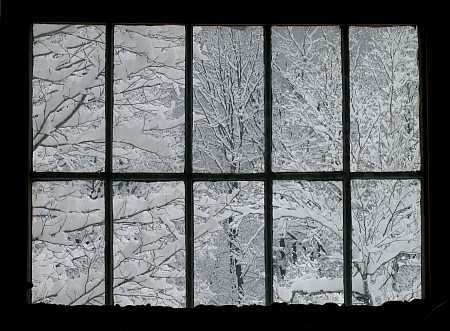
snowA blizzard has begun. Their predictions were right but my vexation at having to reschedule a flight to Vermont subsided with that first sight of accumulation on the streets of Manhattan. I had hoped to experience the storm from some place of sylvan solitude; in lieu of drooping conifers and ivory fields, I turned to Wallace Stevens’s ‘The Snow Man’ (1921) and angled an IKEA chair toward the northeast window.

Since yesterday afternoon I have been mulling over how on earth I might follow the ‘The Broken Tower.’ Now it seems the obvious choice is Stevens. Crane and Stevens are both great 20th century American mystic poets. Both struggled intensely with the ideologies of a Judeo-Christian God and seemed to have favored in the end a form of Gnosticism, or what Stevens called ‘The Presence of an External Master of Knowledge.’ Put simply (something Stevens—and for that matter Crane—would not favor) it is a Oneness, a Oneness with nature, consciousness, all that mystic, Whitmanian jazz.

‘The Snow Man’ presents this sense of the unified whole brilliantly through the complete cohesion between form and content. Usually I would avoid this trope, however it is so well done in this poem that noted linguist Jay Keyser says it is the best short poem in the English language for this very reason. Personally, I feel that’s a stretch but it does accomplish that particular characteristic of great poetry better than any I can think of.

Wallace Stevens

The poem is a single sentence divided into syntactical units by semi-colons. As the poem is read and we arrive at the end of each unit, the mind renders the unit a completion. However each persistent ‘and’ necessitates the reassessment (the re-view) of what was read before and so through the apprehension of the unit, we try to reach the whole. In this way, reading ‘The Snow Man’ is in fact like watching a snowstorm: the eyes follow a portion of flakes down until they reach their supposed journey’s end, the eye then lifts, gathering another segment in its gaze and repeats in an attempt to witness the power of the storm. It is a wonderful analogy for the process of reading and re-reading—a necessary part of loving poetry.

More than this, the poem is the invitation to view things as they appear to you. This poem is more pertinent than ever in a world in which we take in information ceaselessly, clicking the shiny hyperlinks and formulating our opinions based not on the content of the page but the ads that flicker beside them or the inane comments that sit beneath. In the mystic tradition, the ‘nothing that is not there and the nothing that is’ is the void, the presence of absence denoted by the snow that seems to blot out the world by creating one anew. It is the everything out of nothing. The Snow Man sees things as they are because he is constantly reevaluating his position in relation to what is observed. He is aware that he is literally made up of the world that surrounds him—he truly has ‘a mind of winter,’ being a snowman, and knows that his presence in the world is directly affected by that which is outside of him and vice versa. The form and the content of the poem are entreating the reader to stop, pay attention to what they are reading, truly understand every aspect through reanalysis, see what is there and what is not and what is there because it is not there. It is asking you to understand your personal relation to the world and formulate your own opinions accordingly.

Here’s the poem.

The Snow Man

One must have a mind of winter
To regard the frost and the boughs
Of the pine-trees crusted with snow;

And have been cold a long time
To behold the junipers shagged with ice,
The spruces rough in the distant glitter

Of the January sun; and not to think
Of any misery in the sound of the wind,
In the sound of a few leaves,

Which is the sound of the land
Full of the same wind
That is blowing in the same bare place

For the listener, who listens in the snow,
And, nothing himself, beholds
Nothing that is not there and the nothing that is.