 The process of reading as well as the effect it has on us as individuals is only just beginning to be understood. Recent instruments of brain imaging such as positron emission tomography (PET) scans and functional magnetic resonance imaging (fMRI) have unleashed a bevy of information on our own neurology, bringing us closer and closer to understanding that slipping locus: mind. Floating within the liminal space between the empiric and the transcendent is art; at one point it seemed both fields grew parallel to one another, then they seemed to approach infinity asymptotically, now, in the field of neuroaesthetics, their paths will meet.
Emily Dickinson thrusts the entangled nature of art and science and the phenomenological experience of reading into our consciousness by disrupting or displacing it so that we consider our relation to not only what is being read but also our psychological self and our culture as a whole. Like many modern poets, Dickinson uses neologistic linguistic devices to corrupt language, so that we reassess our relation to it and the socio-cultural context in which it is placed. But her primary technique is elision, a method that demands we do not take her
 language for granted and slip into negligent forms of reading or contentment with the world of her poetry. Jean-Michel Basquiat once said, ‘I cross out words so you will see them more: the fact they are obscured makes you want to read more.’ Through linguistic obfuscation or total elision, Dickinson accomplish the same thing, reflecting and elucidating the functions of reading language for the reader.
Stanislas Dehaene’s Reading in the Brain: The Science and Evolution of a Human Invention (2009) offers a relatively simple definition of the neurological complexities in the process of reading. Dehaene writes, ‘Written word processing starts in our eyes. Only the center of the retina, called the fovea, has a fine enough resolution to allow for the recognition of small print. Our gaze must therefore move around the page constantly. Whenever our eyes stop, we recognize one or two words. Each of them is then split up into myriad fragments by retinal neurons and must be put back together before it can be recognized. Our visual system progressively extracts graphemes, syllables, prefixes, suffixes, and root words. Two major parallel processing routes eventually come into play: the phonological route, which converts letters into speech sound, and the lexical route, which gives access to a mental dictionary of word meaning’ (9 [italics mine]).
The act of reading involves the process of encoding, retrieval, and decoding. Overtime our neurons become trained, internalizing graphic signs in constituent parts, i.e. phonemes and graphemes. Each time we look at a word, synapses fire in order for the brain to retrieve information from within memory banks and subsequently sift through their potential meanings. This process occurs within approximately a tenth to a half a second. The eye shifts back and forth intermittently, pausing at moments when the brain decodes small chains of language or when the eye must respond to changes in light or other external shifts in the surrounding environment. These movements of the eye are called saccades. Saccadic movement allows the fovea to scan lines of text, as the fovea is only wide enough to see six to seven characters at a time. The encoded graphic representations of language are then sent (primarily) to an area located in the occipital region of the brain where encoded language is decoded through a process Dehaene calls ‘neuronal recycling,’ allowing the brain to recall patterns and become attuned to the subtleties of language, such as homonym. All of this takes an incredible amount of neurological activity and thus energy and heightens the significance of language in the development of not only culture but also who we are as individuals.
In 1862 Dickinson experienced her greatest moment of personal and mental turmoil, however it was also her most prolific period in which she wrote 366 poems. Capitalizing on the somewhat vague understanding of Dickinson’s condition, psychoanalysts often studied this period of Dickinson’s work to show the significant fragmentation in the processes of thought during psychotic breakdowns. Perhaps her agoraphobia allowed her to regress into her interiority due to little contact with the outside world or maybe her anxiety was sublimated into art (likely both); whatever the cause of her creative energy, it is during this time that her poetry seems to focus most heavily on the manner in which body and brain receive information.
As we have seen in the brief introduction to the neurology of reading, the brain receives graphemes (and most information) in fragmented units and subsequently interprets coherent wholes out of them, oftentimes intercalating the missing pieces. Given that the mind only registers one or two words at each pause, Dickinson’s dash takes on great importance in regard to the way we read and understand her work. In implementing the dash, Dickinson is asking the mind to pause in order for it to register unconsciously what it has just encoded, allowing the decoding process to initiate before the movement to the next graphic chain, thereby providing a neurologic immediacy to the process of reading her work. This is an important aspect of Dickinson’s poetry as her elision often renders syntactical meaning perplexing. Through fragmentation, the brain slows and processes what it is reading, interpolates the elided information, and focuses on the language present. This seems counterintuitive to what the dashes and the abstraction of Dickinson’s work seem to be accomplishing (or not accomplishing) superficially. The dash does sometimes speed up the reader consciously but by placing this meaningless (meaningless in that it has no lexical meaning) graphic, the brain processes the information better. It is this type of poetic trickery or obfuscation that makes her poetry so immediate, so physical. Consider how important each chain becomes in ‘Departed – to the judgment –’(1862):
Departed – to the judgment –
A Mighty Afternoon –
Great Clouds – like Ushers – leaning –
Creation – looking on –
The flesh – Surrendered – Cancelled –
The Bodiless – begun –
Two Worlds – like Audiences – disperse –
And leave the Soul – alone –
She seems aware of the saccadic movement of the eye and the importance it has in reading and is therefore asking us to slow down, to encode/decode the unit before moving on to the next chain or line; she wants our attention to remain for some time on the segments delineated by the dash before continuing and she does not want to fill the space with conjunctions, prepositions or useless language.
The abstraction present in this poem is typical of Dickinson and furthers our desires to pay particular attention to the language. The poem seems to be about the soul’s state after death under that public eye of nature; it is a dying into nature whereby the body is surrendered and cancelled. The setting of the death is a storm. In a letter discussing her growing dependence upon her sister and her fear of being alone, Dickinson writes, ‘Vinnie has been all, so long, I feel the oddest fright at parting with her for an hour, lest a storm arise, and I go unsheltered’ (Letter 200). Storms become an important symbol and metaphor of psychological torment; read this way, the poem is enacting the psychological state of a panic attack. Anxiety is the term for a fear without a specific focus and patients describe them ‘as a simulation of death’ (McDermott). (Dickinson’s panic attacks were probably the reason for her obsession with death and the persistent placement of the speaker in the very act of dying or beyond the grave.) In the poem, ‘Two Worlds’ are leaving the ‘Soul – alone’, one is explicitly the body and so the second (because it cannot be the Soul which leaves the Soul alone) is likely the mind; thus the speaker is experiencing being both without body and without mind. During panic attacks, patients describe the feelings of being disconnected from their body and that they are ‘going insane.’ In this poem Dickinson is relaying through form the psychological distress of death or impending doom whose locus is indeterminate or abstract, hence the poem’s enigmatic nature. The form and content represent that ‘snarl in the brain’ present during her greatest moments of psychological torment.
The cryptic nature of Dickinson’s poetry is also due to the fact that she is often skeptical of religion, afterlife, and morality as well as the manner in which humans are able to receive and subsequently record external phenomena. In her poetry, this skepticism is often the result of the tender and quite capricious nature of the brain’s neurological makeup, which, according to Joseph LeDoux, is what makes the self: he calls this notion the synaptic self. It is clear that synapses allow us to be; the unconscious processes of synaptic firings allow us to breathe, sit, walk, think, speak, read etc. However, LeDoux argues that synapses are as important as nature (genetics) and nurture (or religion, culture etc.). An important aspect of this theory is that because we are consistently changing physiologically, our mindset changes as well. We are, by the very nature of our somewhat whimsical synapses, protean. Helen Vendler writes that Dickinson creates ‘structures that mimic the structure of life at any moment she conceives it’ and ‘[b]y those structures…channels our reactions, adjusts our pace to her and molds our thinking after her own’ (34). Dickinson discusses the manner in which our brains often run counter to ourselves (a theme taken up in my post on Frost’s ‘Spring Pools’) despite our desires to think differently in ‘I felt a Cleaving in my Mind’ (1864).
I felt a Cleaving in my Mind—
As if my Brain had split—
I tried to match it—Seam by Seam—
But could not make it fit.
The thought behind, I strove to join
Unto the thought before—
But Sequence ravelled out of Sound
Like Balls—upon a Floor.
For Dickinson, the fissure in the mind feels like it is a direct result of the brain’s being split: she initiates with the Whitmanian thesis: ‘[w]e do not have a body, we are a body’ (Lehrer). While this poem discusses cognitive disjunction known to everyone, the language chosen as well as the form into which it is placed heightens the problem of the poem by making that very problem latent in the diction and syntax.
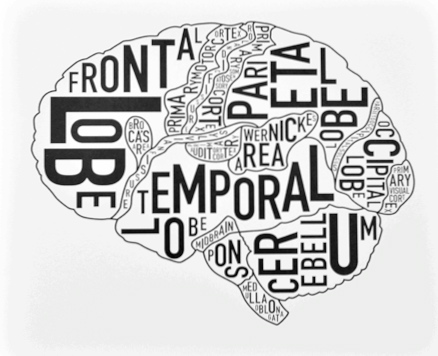
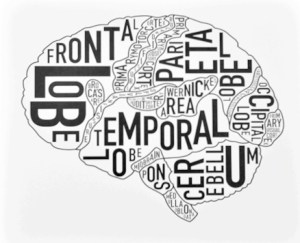 In the process of reading, the visual recognition of word triggers myriad neurological circuits that have been conditioned and fortified through our environment, learning, and reading behaviors. With the recognition of a graphic form as a potential grapheme or word, we begin the process of decoding the smallest groupings of letters into potential words while simultaneously seeking in lexical and auditory memory banks, memories that we can apply to what is seen. The brain does not do this immediately, and so it must sequence patterns of recognition to seek out banks of possible auditory and lexical meaning. Overtime, through the process of reading and ‘neuron recycling,’ the brain becomes aware of homonyms and understands it must differentiate these twinned lexical graphics using contextual signs. However, this is not always immediately possible, and so meanings slide and we fall victim to innocent parapraxis while reading or speaking. In ‘I felt a Cleaving in my Mind’ the difficulty of the poem is substantiated by homonymic difficulties, echoing in the reader’s mind the struggle which Dickinson is discussing.
In the Oxford English Dictionary, the verb cleave has two separate meanings. The first is (1) ‘To part or divide by a cutting blow; to hew asunder; to split’. The second meaning is its exact opposite: (2) ‘To attach to.’ (Because the line break is accentuated by the dash, the brain may register this latter meaning first). At the close of the second line—with that hard split—the meaning becomes clear and the cleaving is a splitting. What makes this homonymic moment more impressive is the fact that Dickinson is lamenting the loss of the second meaning, she in fact wishes her mind would cleave (2) and not cleave (1). This would lack importance if it were an insolated incident within the poem, however Dickinson repeats the lexical trickery with the word ravel. Here ravel in fact has three meanings. (1) ‘To entangle; to confuse, perplex; to render incoherent or muddled;’ (2) ‘of a skein of yarn, a spool or reel of thread, etc.: to become unwound;’ and (3) ‘to knit or bring together.’ The superficial meaning is the first meaning (1): Dickinson cannot connect one thought to the next and is therefore confused. It is the last two meanings that perform the deception. Taking ‘Seam by Seam’ to be a knitting metaphor, ravel initially means that her thoughts are unwound; however, the secondary definition means that in its becoming unwound it is knit together, just as one must unravel a spool of thread to ravel (knit) an article of clothing. The sequence (patterning) ravels out of caterwauling auditory input (‘Balls – upon a floor’) and Dickinson is consciously unable to align her thinking patterns to that sequence; though subconsciously, on a neurological level, the brain is making meaning: on a superficial level the disparate meaning of lexical input is consciously rendered cryptic and yet meaning arises out of the mind’s ability to pattern properly, however unlikely it seems.
In her use of dichotomous language, Dickinson is lamenting not the fact that she cannot think properly but rather that this is in fact the process of thought, especially in times of psychological distress. The cleaving of the mind as a result of the brain’s splitting continues the theme of being disconnected from her body, and in that disconnect her thoughts become subject to the seemingly arbitrary will of synaptic energies, however it is those very energies that create the poem. Two years prior to the composition of this poem, and during a tumultuous time, Dickinson wrote on the notion of the brain’s arbitrary connections in ‘The Brain, within its Groove’ (1862):
The Brain, within its Groove
Runs evenly—and true—
But let a Splinter swerve—
‘Twere easier for You—
To put a Current back—
When Floods have slit the Hills—
And scooped a Turnpike for Themselves—
And trodden out the Mills—
This poem is attuned to LeDoux’s notion of the synaptic self whereby the self, as much at is informed by culture, religion, etc. is really dependent upon patterns of synapse. The brain is plastic and is changing constantly through synapses as we continue to change day to day. This plasticity not only literally reshapes our minds but also our personality, our thoughts and even our beliefs. Dickinson is stating, as countless neurologists have stated (and recidivists proven), it is easier to learn than it is to unlearn.
***
Works Cited:
Dehaene, Stanislas. Reading in the Brain: The Science and Evolution of a Human Invention. New York: Penguin Books, 2009.
Dickinson, Emily. The Letters of Emily Dickinson. Eds. Thomas H. Johnson & Theodora Ward, Cambridge: Harvard University Press, 1958.
Johnson, Thomas H. The Complete Poems of Emily Dickinson. Boston: Little, Brown and Company, 1960.
LeDoux, Joseph. Synaptic Self: How Our Brains Become Who We Are. New York: Penguin Books, 2003.
Lehrer, Jonah. Proust was a Neuroscientist. New York: Houghton Mifflin Company, 2007.
McDermott, John F. ‘Emily Dickinson’s “Nervous Prostration” and its Possible Relation to Her Work .’Emily Dickinson Journal. 9.1 (2008): 71-86.
Vendler, Helen. ‘Emily Dickinson Thinking.’ Parnassus 26.1 (2001): 34-56.







 The question of the appeal of modern poetry is a very big concern among modernists and a common question among readers new to the genre. Many prefer the aesthetics of the Elizabethan’s, enjoying the sing-song simplicity and rhyme. Often, when I tell people that I am passionate about modern poetry they ask, ‘Why?’ Some objectors of the place of poetry even use (in so many words) W.H. Auden’s line in his elegy to W.B. Yeats, seemingly unaware of the contradiction: ‘poetry makes nothing happen.’
 The Broken Towers