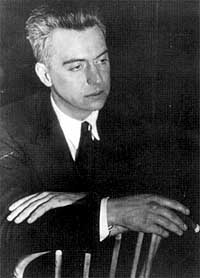
Hart Crane’s ‘Voyages II’

*
Hart Crane
Hart Crane

Lorine Niedecker’s Neuroaesthetics

*

This is part two of my posts on the neurology of reading in poetry. If you have not yet read the previous post on Dickinson, I would recommend that you do so first, as there are some important concepts that are integral to understanding this attempt at Lorine Niedecker’s (1903-1970) work. I chose Niedecker for two reasons: the first is the obvious connection of her writing to Dickinson’s and the second was because of this quote: ‘Gail Roub asked Lorine once: “Who are you?” [She answered,] 
‘William Carlos Williams said I am the Emily Dickinson of my time.”’

Emily Dickinson and Lorine Niedecker

Emily Dickinson and Lorine Niedecker

Niedecker almost perpetually inhabits a liminal zone; in fact, she seemed to demand this position throughout her life. Living as a self-described ‘laborer’ and as a poet allowed her to dwell in both the physical and the abstract. She built her cabin along the waters of Rock River in Wisconsin, fulfilling that classic, melancholic image of the ruminative figure standing on the shore gazing into the infinity of sky and water. Jenny Penberthy points to this disposition of liminality several times in her introduction to Lorine Niedecker: Collected Works (2002). She writes, ‘[Her] poems offer a rich and subtle study of folk habits made by a poet with twin allegiances to a rural backwater and a metropolitan avant-garde’ (6). And in an essay on Niedecker, Penberthy continues: melancholy ‘She’s drawn to threshold states, to boundaries between the familiar and the alien, between the facilitating contours of syntax and an alien content. In other poems where the hold on syntax loosens, she pushes further into pre-discursive language, into the non-expressive, into the abstract.’

With an understanding of the neurology of reading, it becomes clear that Niedecker’s projects progress beyond mere experiments in abstraction. Her poems consistently demand something more from the reader, something beyond the trancelike state in which she may have composed them.

The process of reading a written word occurs within a tenth to a half a second and we maintain in our memory the graphic or symbolic expanse of what is seen and its relation to what precedes or follows it, this allows us to make meaning contextually if our mental dictionary of word meaning does not immediately recognize the word. The mental dictionary of word meaning is different in each person. It is dependent upon culture, learning, etc.; as one moves from culture to culture, from semantic space to semantic space, meaning varies through slippage. Already Niedecker’s ‘abstraction’ is significant, as it seems to rely on the unreliability of the reader’s recognition and understanding. In Niedecker’s poetry—which desires to assert an inter-subjective meaning between the spaces of personal significance—slippage and linguistic trickery that relies on the irregularity of the saccadic eye becomes key.

The inherent formula of poetry allows Niedecker a field to assert these two techniques, given that ‘whenever our eyes stop, we recognize [only] one or two words.’ In a letter to Roub, Niedecker describes what she is attempting with her poetry: ‘Much taken up with how to define a way of writing poetry which is not Imagist nor Objectivist fundamentally nor Surrealism alone…. I loosely called it “reflections” or as I think it over now, reflective, maybe. The basis is direct and clear what has been seen or heard-but something gets in, overlays all that to make a state of consciousness…. The visual form is there in the background and the words convey what the visual form gives off after it’s felt in the mind’ (Roub 41).

Take a segment from part V of ‘Progression’:

In Swalery I forgot my face,
beyond that it’s something to have under a sunbonnet
when aphorists and haymakers meet. And doctor,
nothing so good I know for intricate rhyme schemes
in six-syllable lines with ten syllable lines
of an evangelical staple as bug-sing and carrot seed,
observe now, while perspective is the next show
in the gallery, it’s a fervid shade, and there’ll be
stricken areas in the throat waiting for the blowing.
A touch of noon? Try then: each man to his own sleep
in the night skies. Gaspaciousness enmillions
dread-centric introspectres. Future studies
will throw much darkness on the home-talk.

The difficulty of this excerpt demands rereading and subsequent explication (one can revel in the sounds and that is fine), and, as I have stated, it is this demand that renders meaning within the poem.

In this poem, Niedecker compresses the distance between language and culture. The segment begins with a setting that becomes at once no place and every place due to the ambiguity of Swalery (as far as I can tell Swalery does not exist). Niedecker immediately asserts the ubiquity of female oppression within the realm of sexual politics. The face becomes something beneath the obscuring, female ‘sunbonnet’ to be worn when hosting. The semantic field of ‘sunbonnet’ seems to infantilize women as well, as it is infants that now primarily wear them. The infantilized state is continued in the youthful, perhaps uneducated syntax ‘doctor / nothing so good I know for,’ which is followed by the statement of her roles as poet and laborer, declaring her self-sufficiency in dialectical terms, that is as the diminished female, the empowered female poet, and then again the diminished female whose labor is confined to the garden:

[diminished–>]nothing so good I know for [empowered –>] intricate rhyme/schemes/in six-syllable lines within ten-syllable lines/
of an evangelical staple as [diminished –>] bug-sing and carrot seed

Finally her statement ‘Future studies / will throw much darkness on the home-talk’ seems to predict (in the temporal realm of the poem) sexual revolutions, the empowerment of the female, and the subsequent vexation of the male in regard to that power.

The most fascinating and wonderful part about this poem is the sentence ‘Gaspaciousness enmillions / dread-centric introspectres.’ It is here that Niedecker is operating within that liminal zone between abstraction and meaning. Neurologically, the synaptic pathways responsible for encoding and decoding are interrupted by the unrecognizable words. All that becomes important on the first read through is that very important aspect of poetry, sound. ‘Mental conversion into sound plays an essential role when we read a word for the first time. Initially we cannot possibly access its meaning directly, since we have never seen the word spelled out. All we can do is to convert it into sound, find that the sound pattern is intelligible, and through this indirect route, come to understanding the word. Thus sounding is often the only solution when we encounter a new word’ (Dehaene 27).
It is easy to dismiss these lines of poetry as mere sounds or useless units of language. As Dehaene writes, ‘English has a particularly extensive collection of complex graphemes such as “ought,” “oi,” and “au.” Our visual system has learned to treat these groups as bona fide units, to the point where we no longer pay attention to their actual letter content.’ But with a close, albeit subjective reading, the neologisms develop great and personal meaning for readers as well as Niedecker herself. Through the process of memory and word recognition, we can project meaning onto the neologisms. The preceding sentence slowly unfolds as a declaration of death between the line breaks:

each man to his own sleep
in the night skies.

As the result of the deaths of these men, the speaker is haunted by not necessarily their deaths but the demons it manifests within the self. The root words in gaspaciousness are gas, space, and –ness; gas-space is the gas that fills space and the –ness turns the word into a noun, so a synonym would be something like ether. Enmillions is easy: the prefix –en forms a verb, so it simply means ‘makes millions’. Dread-centric can only mean concerned with dread and introspectres (intro+spectres) means inner ghosts, or colloquially inner demons. ‘Gaspaciousness enmillions / dread-centric introspectres’ means, then: ‘Out of the ether is made millions of inner-demons that cause dread’ i.e. guilt, fear, etc. It is this difficult, seemingly nonsensical sentence upon which the entire poem turns, as it encapsulates the anxieties of being a cultural being suffused in the complexity of a language delineating the very complexities of that culture.

In this disruption or transmogrification of language, Niedecker opens the readers to new categories of thought by exploring human experience through the use of various possibilities of language. In her own exploration of human experience and linguistic experimentation, she also places the experience of the reader in the fore; the reader’s role becomes central to the entire process, dependent upon culturally varying memory banks. Niedecker once wrote in a letter to Gail Roub, ‘I like planting poems in deep silence, each person gets at the poems for himself.’ Dickinson’s poetics accomplish the same things: ‘Dickinson may encourage us to pay more attention to our own perception of texts and reflect on figures of cognition and their cognitive effects on processes of reading’ (Sielke 69). It is not merely this assertion of subjectivity that Niedecker and Dickinson have in common. In a poem like ‘Progression’, Niedecker repeats the same techniques in Dickinson’s ‘I felt a Cleaving in my Mind’; however, whereas Dickinson placed the complexity almost wholly within the mind, Niedecker explicitly places the interiority of the speaker into a cultural context.

Dickinson and Niedecker’s sometimes nonsensical lines demand that the reader (on a conscious and subconscious level) considers more deeply the perplexing graphic representations put forth on the page as the saccadic eye drifts into the aporetic space of line breaks. Through obfuscation, meaning is rendered more immediately and viscerally. Their success at this (and therefore the success of their poetry) is due to the ability to give multiple meanings to language that is either present outside of our linguistic territory; that is, to operate within the liminal position between complete linguistic abstraction and objective meaning rife with psychological and or cultural significance.

Works Cited

Dehaene, Stanislas. Reading in the Brain: The Science and Evolution of a Human Invention. New York: Penguin Books, 2009. Print.

Penberthy, Jenny. ‘A little too little: Re-reading Lorine Niedecker.’ Modern American Poetry. http://www.english.illinois.edu/. Web. 21 May 2013.

Penberthy, Jenny. Lorine Niedecker: Collected Works. 1. University of California Press, 2002. Print.

Roub, Gail. ‘Getting to Know Lorine Niedecker.’ Wisconsin Academy Review. 32.3 (1986): 37-41. Print.

Stanley Kunitz: The Testing-Tree

*

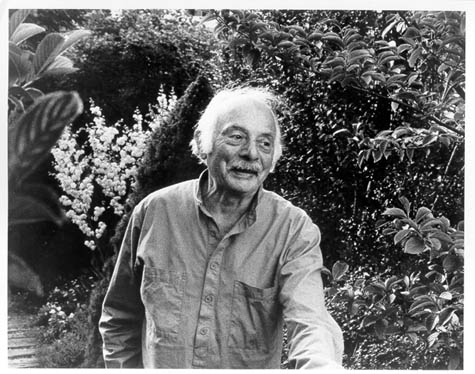
Magic LanternI haven’t dreamed in months. My brain is numb with thinking, burned-out, gutted. I wake each morning to only the hoary, fragmented recollection of the pages I was reading before I fell into sleep, adrift in the glow of the kitchen light. I know that dreams had flickered and doused like lights in an electric storm, but they are impossibly distant (magic) lanterns and the mind’s nights are uneventful. So I have turned again to my dreamer, Stanley Kunitz.


Kunitz makes it into every important anthology and yet I’ve never heard his name murmured by graduates of verse in any 
New York City dive. Kunitz died in 2006 at the age of 100 and he racked up every important literary award and position along Kunitz1the way. His honors include the National Book Award, the Bollingen Prize, a Guggenheim Foundation fellowship, the State Poet of New York, the Pulitzer Prize, and the United States Poet Laureate. But no one seems to be writing or talking about this contemporary of Eliot, Pound, Frost, Stevens etc. whose wide-reaching influence includes Theodore Roethke, W.H. Auden, Robert Lowell, and so forth and so on until the early 21st century.

Kunitz’s ‘The Testing-Tree’ is one of his most visionary poems. In it, he progresses from a reflection on his childhood to, as he states, a recurring dream. In future, I will likely provide some entryways into the poem . But for now, I think it should only be read and read again. All I will say is listen to the voice. This is a voice that has lived. A voice that has loved and hurt, hurt and plunged, plunged and risen. It is an authoritative and chilling voice; a human voice whose heart ‘breaks and breaks / and lives by breaking.’ His is a voice that has dreamed and dreamed and dreamed.

Here’s the poem:

The Testing-Tree

1

On my way home from school
   up tribal Providence Hill
      past the Academy ballpark
where I could never hope to play
   I scuffed in the drainage ditch
      among the sodden seethe of leaves
hunting for perfect stones
   rolled out of glacial time
      into my pitcher's hand;
then sprinted lickety-
   split on my magic Keds
      from a crouching start,
scarcely touching the ground
   with my flying skin
      as I poured it on
for the prize of the mastery
   over that stretch of road,
      with no one no where to deny
when I flung myself down
   that on the given course
      I was the world's fastest human.


2

Around the bend
   that tried to loop me home
      dawdling came natural
across a nettled field
   riddled with rabbit-life
      where the bees sank sugar-wells
in the trunks of the maples
   and a stringy old lilac
      more than two stories tall
blazing with mildew
   remembered a door in the 
      long teeth of the woods.
All of it happened slow:
   brushing the stickseed off,
      wading through jewelweed
strangled by angel's hair,
   spotting the print of the deer
      and the red fox's scats.
Once I owned the key
   to an umbrageous trail
      thickened with mosses
where flickering presences
   gave me right of passage
      as I followed in the steps
of straight-backed Massassoit
   soundlessly heel-and-toe
      practicing my Indian walk.


3

Past the abandoned quarry
   where the pale sun bobbed
      in the sump of the granite,
past copperhead ledge,
   where the ferns gave foothold,
      I walked, deliberate,
on to the clearing,
   with the stones in my pocket
      changing to oracles
and my coiled ear tuned
   to the slightest leaf-stir.
      I had kept my appointment.
There I stood in the shadow,
   at fifty measured paces,
      of the inexhaustible oak,
tyrant and target,
   Jehovah of acorns,
      watchtower of the thunders,
that locked King Philip's War
   in its annulated core
      under the cut of my name.
Father wherever you are
    I have only three throws
       bless my good right arm.
In the haze of afternoon,
   while the air flowed saffron,
      I played my game for keeps--
for love, for poetry,
   and for eternal life--
      after the trials of summer.

4

In the recurring dream
   my mother stands
      in her bridal gown
under the burning lilac,
   with Bernard Shaw and Bertie
      Russell kissing her hands;
the house behind her is in ruins;
   she is wearing an owl's face
      and makes barking noises.
Her minatory finger points.
   I pass through the cardboard doorway
      askew in the field
and peer down a well
   where an albino walrus huffs.
      He has the gentlest eyes.
If the dirt keeps sifting in,
   staining the water yellow,
      why should I be blamed?
Never try to explain.
   That single Model A
      sputtering up the grade
unfurled a highway behind
   where the tanks maneuver,
      revolving their turrets.
In a murderous time
   the heart breaks and breaks
      and lives by breaking.
It is necessary to go
   through dark and deeper dark
      and not to turn.
I am looking for the trail.
   Where is my testing-tree?
      Give me back my stones!

W.B. Yeats: The Fascination of What’s Difficult

*

William Butler Yeats, Irish poet

William Butler Yeats, Irish poet

I want to continue with the idea of modern difficulty but first, a digression. In my previous post I mentioned the irony inherent in W.H. Auden’s elegy to William Butler Yeats, ‘poetry makes nothing happen.’  (Link to Auden reading the first part of poem below.) The primary irony I was referring to was using a line of poetry to dismiss poetry. The second regarded the significance of the elegy. Yeats was an Irish Nationalist, however his active involvement in the cause varied through time. Despite this, he was a catalyst for the Irish Literary Revival and wrote some of the most significant elegies for the Irish political plight, immortalizing in verse the moment in time and those involved. This of course is not ‘nothing.’  In the poem, Auden questions the social viability of art but the irony is that he does it through poetry, or what he calls the mouth, perhaps the most viable option for change. The question to ask is how can poetry ‘make nothing happen’ while simultaneously being ‘a way of happening’? This is from part II of Auden’s elegy:

You were silly like us; your gift survived it all:
The parish of rich women, physical decay,
Yourself. Mad Ireland hurt you into poetry.
Now Ireland has her madness and her weather still,
For poetry makes nothing happen: it survives
In the valley of its making where executives
Would never want to tamper, flows on south
From ranches of isolation and the busy griefs,
Raw towns that we believe and die in; it survives,
A way of happening, a mouth.

That’s the end of the digression. Some food for thought. Now let’s move on to Yeats’s poetics.

‘Modern Poetry’ anthologies often begin with Yeats because he straddled the line between Romanticism and what we call Modernism. Yeats struggled with his position both temporally and artistically. In terms of the latter, he often vacillated (poetically and politically, Yeats was clearly indecisive). In any event, in his poem ‘Coole and Ballyhee, 1931’ he wrote, ‘we are the last romantics.’ (Most poets after Yeats will have you believe they had severed all allegiances to Romanticism—don’t believe them. Eliot himself was a covert Romantic.)

Yeats’s poem ‘The Fascination of What’s Difficult’ (1912) is an interesting poem regarding his liminal position between romanticism and modernism. He begins by stating that the admiration for ‘what’s difficult’ has left him empty of spontaneous poetic power (Yeats was interested in the occult, especially Hermeticism and automatic writing); he is both ‘rent’ (without) of ‘natural content’ meaning poetic power and material and ‘content’ meaning happiness. He is complaining about the movement toward modernism and how the pedantry necessary for it will take the joy out of writing. However, the poem is also about freeing the Pegasus, the colt that symbolizes poetry. There is a natural strain in Yeats’s poem; at once a freeing and a containing: the bounding colt now seems as though it ‘drag[s] road metal’ and is stabled.

en: Portrait of William Butler Yeats by John S...

During the poem’s composition, Yeats was running the Abbey Theatre (consider the theme of the stage in the last post on Stevens). Here it seems it is the ‘Theatre business, management of men’ that pulled him from romantic Irish mysticism to the world of modernity. This poem, through form and content, so cleverly portrays the inherent struggle with desiring to move forward while longing for the past. It is a nostalgia recollected at the moment of significant, positive personal change. Yeats sees and understands the fascination of what’s difficult. In pulling out the bolt he frees the Pegasus, allowing him to write however he wants. He refuses to give in to the pedantry of modernism, to ‘shiver under the lash, strain, sweat and jolt’, and so should readers of modern poetry. Yeats was a modern poet but he never lost sight of the Pegasus. So take from all poetry what you see and capitalize on change but never compromise yourself.

Here’s the poem.

The Fascination of What’s Difficult

The fascination of what’s difficult
Has dried the sap out of my veins, and rent
Spontaneous joy and natural content
Out of my heart. There’s something ails our colt
That must, as if it had not holy blood,
Nor on an Olympus leaped from cloud to cloud,
Shiver under the lash, strain, sweat and jolt
As though it dragged road metal. My curse on plays
That have to be set up in fifty ways,
On the day’s war with every knave and dolt,
Theatre business, management of men.
I swear before the dawn comes around again
I’ll find the stable and pull out the bolt.

Wallace Stevens: Of Modern Poetry

*

The question of the appeal of modern poetry is a very big concern among modernists and a common question among readers new to the genre. Many prefer the aesthetics of the Elizabethan’s, enjoying the sing-song simplicity and rhyme. Often, when I tell people that I am passionate about modern poetry they ask, ‘Why?’ Some objectors of the place of poetry even use (in so many words) W.H. Auden’s line in his elegy to W.B. Yeats, seemingly unaware of the contradiction: ‘poetry makes nothing happen.’

When I consider what people call the difficulty of modern poetry I think of two things, T.S. Eliot’s essay ‘The Metaphysical Poets’ and Wallace Stevens’s poem ‘Of Modern Poetry.’ Eliot writes, ‘Our civilization comprehends great variety and complexity, and this variety and complexity, playing upon a refined sensibility, must produce various and complex results. The poet must become more and more comprehensive, more allusive, more indirect, in order to force, to dislocate if necessary, language into his meaning.’ Here modernists might discuss modernism’s tearing into pieces of the interiority of humanity as a result of some great event, and I do not deny that modernism consists of the ‘refined sensibility’ reacting to that (or those) events. However, the events and the emotions tied to the events are seldom new (though the events may be more monumental, the emotions more intense); the difficulty is in the projection of a subjective interiority that has always existed and has always been complex.

Modern art in PragueWallace Stevens’s ‘Of Modern Poetry’ begins with what I believe is a sense of Durkheim’s social Anomie. Modern poetry is the attempt to grasp and delineate something that cannot yet be understood by society at large. In this sense it is prophesying: modern poetry ‘has / To construct a new stage’ on which the norms of society will be played out after it is ruptured by anything: war, economic collapse, drought, etc. Stevens’s act of poetry, which is the act of the mind, is simultaneously solipsistic and intersubjective: it is for the self and the ‘invisible audience’ or collective consciousness of humanity. Stevens repeats what Keats wrote in ‘A Defence of Poetry’ [sic] : ‘Poets are the unacknowledged legislators of the world’ (Anomie is from the Greek and translates to ‘without law’). In times of great variety and complexity, the mind will mirror that state. ‘The poem of the act of the mind’ is ‘difficult’ because it is the mapping of the intricacy of your (his, hers, theirs, our) mind. Poetry is there to recreate, to compose law, it is there to remind us of what it is that makes us human, and, more importantly, to remind us of what makes us a society.

Here’s the poem.

Of Modern Poetry

The poem of the mind in the act of finding
What will suffice. It has not always had
To find: the scene was set; it repeated what
Was in the script.
Then the theatre was changed
To something else. Its past was a souvenir.

It has to be living, to learn the speech of the place.
It has to face the men of the time and to meet
The women of the time. It has to think about war
And it has to find what will suffice. It has
To construct a new stage. It has to be on that stage,
And, like an insatiable actor, slowly and
With meditation, speak words that in the ear,
In the delicatest ear of the mind, repeat,
Exactly, that which it wants to hear, at the sound
Of which, an invisible audience listens,
Not to the play, but to itself, expressed
In an emotion as of two people, as of two
Emotions becoming one. The actor is
A metaphysician in the dark, twanging
An instrument, twanging a wiry string that gives
Sounds passing through sudden rightnesses, wholly
Containing the mind, below which it cannot descend,
Beyond which it has no will to rise.
It must
Be the finding of a satisfaction, and may
Be of a man skating, a woman dancing, a woman
Combing. The poem of the act of the mind.