Pablo Neruda’s ‘Walking Around’

Art, Poems, Poetry
Neruda
Pablo Neruda
Bly
Robert Bly

W.B. Yeats: The Fascination of What’s Difficult

*

William Butler Yeats, Irish poet

William Butler Yeats, Irish poet

I want to continue with the idea of modern difficulty but first, a digression. In my previous post I mentioned the irony inherent in W.H. Auden’s elegy to William Butler Yeats, ‘poetry makes nothing happen.’  (Link to Auden reading the first part of poem below.) The primary irony I was referring to was using a line of poetry to dismiss poetry. The second regarded the significance of the elegy. Yeats was an Irish Nationalist, however his active involvement in the cause varied through time. Despite this, he was a catalyst for the Irish Literary Revival and wrote some of the most significant elegies for the Irish political plight, immortalizing in verse the moment in time and those involved. This of course is not ‘nothing.’  In the poem, Auden questions the social viability of art but the irony is that he does it through poetry, or what he calls the mouth, perhaps the most viable option for change. The question to ask is how can poetry ‘make nothing happen’ while simultaneously being ‘a way of happening’? This is from part II of Auden’s elegy:

You were silly like us; your gift survived it all:
The parish of rich women, physical decay,
Yourself. Mad Ireland hurt you into poetry.
Now Ireland has her madness and her weather still,
For poetry makes nothing happen: it survives
In the valley of its making where executives
Would never want to tamper, flows on south
From ranches of isolation and the busy griefs,
Raw towns that we believe and die in; it survives,
A way of happening, a mouth.

That’s the end of the digression. Some food for thought. Now let’s move on to Yeats’s poetics.

‘Modern Poetry’ anthologies often begin with Yeats because he straddled the line between Romanticism and what we call Modernism. Yeats struggled with his position both temporally and artistically. In terms of the latter, he often vacillated (poetically and politically, Yeats was clearly indecisive). In any event, in his poem ‘Coole and Ballyhee, 1931’ he wrote, ‘we are the last romantics.’ (Most poets after Yeats will have you believe they had severed all allegiances to Romanticism—don’t believe them. Eliot himself was a covert Romantic.)

Yeats’s poem ‘The Fascination of What’s Difficult’ (1912) is an interesting poem regarding his liminal position between romanticism and modernism. He begins by stating that the admiration for ‘what’s difficult’ has left him empty of spontaneous poetic power (Yeats was interested in the occult, especially Hermeticism and automatic writing); he is both ‘rent’ (without) of ‘natural content’ meaning poetic power and material and ‘content’ meaning happiness. He is complaining about the movement toward modernism and how the pedantry necessary for it will take the joy out of writing. However, the poem is also about freeing the Pegasus, the colt that symbolizes poetry. There is a natural strain in Yeats’s poem; at once a freeing and a containing: the bounding colt now seems as though it ‘drag[s] road metal’ and is stabled.

en: Portrait of William Butler Yeats by John S...

During the poem’s composition, Yeats was running the Abbey Theatre (consider the theme of the stage in the last post on Stevens). Here it seems it is the ‘Theatre business, management of men’ that pulled him from romantic Irish mysticism to the world of modernity. This poem, through form and content, so cleverly portrays the inherent struggle with desiring to move forward while longing for the past. It is a nostalgia recollected at the moment of significant, positive personal change. Yeats sees and understands the fascination of what’s difficult. In pulling out the bolt he frees the Pegasus, allowing him to write however he wants. He refuses to give in to the pedantry of modernism, to ‘shiver under the lash, strain, sweat and jolt’, and so should readers of modern poetry. Yeats was a modern poet but he never lost sight of the Pegasus. So take from all poetry what you see and capitalize on change but never compromise yourself.

Here’s the poem.

The Fascination of What’s Difficult

The fascination of what’s difficult
Has dried the sap out of my veins, and rent
Spontaneous joy and natural content
Out of my heart. There’s something ails our colt
That must, as if it had not holy blood,
Nor on an Olympus leaped from cloud to cloud,
Shiver under the lash, strain, sweat and jolt
As though it dragged road metal. My curse on plays
That have to be set up in fifty ways,
On the day’s war with every knave and dolt,
Theatre business, management of men.
I swear before the dawn comes around again
I’ll find the stable and pull out the bolt.

Robert Frost: Spring Pools

*

Robert Frost, American poet

Not uncommon to the northeast, our weather has been rather erratic this year. A week or so ago I walked through the park in a long-sleeve and today I’ve become something of a frigophobic. In any event, sustained warmth is approaching; and because of this there is a widespread air of relief among those that are out-of-doors, a latent optimism ready to spring. This type of optimism is not such a positive thing. It is, rather unfortunately, a form of the modern American condition: in winter, we whimper for warmth, come spring and summer, we grumble under the sun. Doubtless, we lack presence; or perhaps we’re a lot of malcontents. The former is more poetic. As I thought about this, Robert Frost’s ironic and incongruent nature struck me, particularly in his poem ‘Spring Pools’ (1928).

‘Spring Pools’ is the first poem in Frost’s 1928 collection titled West-Running Brook. The male speaker in the title poem ‘West-Running Brook,’ comes to take on a rather pragmatic reading of the brook and nature in general. It is difficult to isolate a single excerpt from the poem without desiring to quote the poem’s entirety but here is the ‘gist’ of the poem:

‘Speaking of contraries, see how the brook
In that white wave runs counter to itself
It is from that water we were from
Long, long before we were from any creature.
Here we, in our impatience of the steps,
Get back to the beginning of beginnings,
The stream of everything that runs away.
Some say existence like a Pirouot
And Pirouette, forever in one place,
Stands still and dances, but it runs away;
It seriously, sadly, runs away
To fill the abyss’s void with emptiness.
It flows beside us in the water brook,
But it flows over us. It flows between us
To separate us for a panic moment.
………………………………………………………..
Our life runs down in sending up the clock.
The brook runs down in sending up our life.
The sun runs down in sending up the brook.
And there is something sending up the sun.
It is this backward motion toward the source,
Against the stream, that most we see ourselves in,
The tribute of the current of the source.
It is from this in nature we are from.
It is most us.’                                  
                                -Lines 38-73

Reflection_2Emerson, a very important philosopher for Frost, writes in his essay ‘Nature’ (1836), ‘Who looks upon a river in a meditative hour and is not reminded of the flux of all things?’ Both ‘West-Running Brook’ and ‘Spring Pools’ are about the Emersonian flux, but they are dealt with entirely differently. More important than this common motif, is the Emersonian desire for presence. In ‘The Over-Soul’ (1841) (an essay that also discusses the omniscient flow of nature, as in the excerpt above) Emerson writes, ‘Do not require a description of the countries towards which you sail. The description does not describe them to you, and to-morrow you arrive there, and know them by inhabiting them.’ He means don’t strive to look into the future because we ‘will learn that there is no profane history; that all history is sacred; that the universe is represented in an atom, in a moment of time. He will weave no longer a spotted life of shreds and patches, but he will live with a divine unity. He will cease from what is base and frivolous in his life, and be content with all places…’ ‘West-Running Brook’ is about (among other things) accepting Time and Nature. ‘Spring Pools’, again the first poem of the collection, wishes to deny the course with (what I think is a sad) hubris.

The difference between the flow of the brook in ‘West-Running Brook’ and the trees in ‘Spring Pools’ is one of power dynamics. For Frost, the trees are tyrants, siphoning water and beauty from the smaller plants and the reflective pools through their xylem in order to secure their own splendor. The trees’ foliage garnered through this violent extraction would then ‘blot out’ the forest floor from the sun, killing more plants. Frost deems the trees malevolent (‘pent-up buds’ is, I think, a sinister language) and disregards the pragmatism in ‘West-Running Brook’—that Nature and Time ‘seriously, sadly, runs away’— preferring that the moment be sustained. He desires a presence akin to Emerson’s but without the consequence of death. He asserts this desire with phlegmatic hubris: ‘Let them think twice before they use their powers / To blot out and drink up and sweep away / These flowery waters and these watery flowers’ but the final line is stated with such a downhearted tone (note the word ‘only’) that we feel for the hubristic old man striving to stop the currents of time as we might feel for Milton’s Satan: ‘From snow that melted only yesterday.’

Throughout West-Running Brook nature becomes ‘dark,’ a sinister but necessary thing. In ‘Spring Pools,’ I believe Frost is cynically portraying a reversal of the American mind that will become corrected throughout the collection, reaching its culmination in ‘West-Running Brook,’ which asserts an understanding of flux. We must accept the way things are despite our own stubborn desires for something different. We must be the wave we are and learn to ‘run counter’ to ourselves. It will be winter for some time, but spring is soon to come.

Here’s the poem. Listen to the poem (read by Ted Hughes) by clicking the link below.

Spring Pools

These pools that, though in forests, still reflect
The total sky almost without defect,
And like the flowers beside them, chill and shiver,
Will like the flowers beside them soon be gone,
And yet not out by any brook or river,
But up by roots to bring dark foliage on.

The trees that have it in their pent-up buds
To darken nature and be summer woods—
Let them think twice before they use their powers
To blot out and drink up and sweep away
These flowery waters and these watery flowers
From snow that melted only yesterday.

Ted Hughes reading ‘Spring Pools’

A Mind of Winter: Wallace Stevens’s ‘The Snow Man’

*

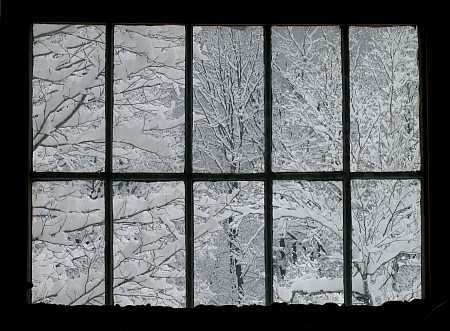
snowA blizzard has begun. Their predictions were right but my vexation at having to reschedule a flight to Vermont subsided with that first sight of accumulation on the streets of Manhattan. I had hoped to experience the storm from some place of sylvan solitude; in lieu of drooping conifers and ivory fields, I turned to Wallace Stevens’s ‘The Snow Man’ (1921) and angled an IKEA chair toward the northeast window.

Since yesterday afternoon I have been mulling over how on earth I might follow the ‘The Broken Tower.’ Now it seems the obvious choice is Stevens. Crane and Stevens are both great 20th century American mystic poets. Both struggled intensely with the ideologies of a Judeo-Christian God and seemed to have favored in the end a form of Gnosticism, or what Stevens called ‘The Presence of an External Master of Knowledge.’ Put simply (something Stevens—and for that matter Crane—would not favor) it is a Oneness, a Oneness with nature, consciousness, all that mystic, Whitmanian jazz.

‘The Snow Man’ presents this sense of the unified whole brilliantly through the complete cohesion between form and content. Usually I would avoid this trope, however it is so well done in this poem that noted linguist Jay Keyser says it is the best short poem in the English language for this very reason. Personally, I feel that’s a stretch but it does accomplish that particular characteristic of great poetry better than any I can think of.

Wallace Stevens

The poem is a single sentence divided into syntactical units by semi-colons. As the poem is read and we arrive at the end of each unit, the mind renders the unit a completion. However each persistent ‘and’ necessitates the reassessment (the re-view) of what was read before and so through the apprehension of the unit, we try to reach the whole. In this way, reading ‘The Snow Man’ is in fact like watching a snowstorm: the eyes follow a portion of flakes down until they reach their supposed journey’s end, the eye then lifts, gathering another segment in its gaze and repeats in an attempt to witness the power of the storm. It is a wonderful analogy for the process of reading and re-reading—a necessary part of loving poetry.

More than this, the poem is the invitation to view things as they appear to you. This poem is more pertinent than ever in a world in which we take in information ceaselessly, clicking the shiny hyperlinks and formulating our opinions based not on the content of the page but the ads that flicker beside them or the inane comments that sit beneath. In the mystic tradition, the ‘nothing that is not there and the nothing that is’ is the void, the presence of absence denoted by the snow that seems to blot out the world by creating one anew. It is the everything out of nothing. The Snow Man sees things as they are because he is constantly reevaluating his position in relation to what is observed. He is aware that he is literally made up of the world that surrounds him—he truly has ‘a mind of winter,’ being a snowman, and knows that his presence in the world is directly affected by that which is outside of him and vice versa. The form and the content of the poem are entreating the reader to stop, pay attention to what they are reading, truly understand every aspect through reanalysis, see what is there and what is not and what is there because it is not there. It is asking you to understand your personal relation to the world and formulate your own opinions accordingly.

Here’s the poem.

The Snow Man

One must have a mind of winter
To regard the frost and the boughs
Of the pine-trees crusted with snow;

And have been cold a long time
To behold the junipers shagged with ice,
The spruces rough in the distant glitter

Of the January sun; and not to think
Of any misery in the sound of the wind,
In the sound of a few leaves,

Which is the sound of the land
Full of the same wind
That is blowing in the same bare place

For the listener, who listens in the snow,
And, nothing himself, beholds
Nothing that is not there and the nothing that is.